Tamzin MacDonald, Financial Manager of IGrow Accounting and Tax Advisory, shares her expert input for private rental property owners on the topic of ring-fencing losses in your tax returns. If you’re building a rental property portfolio in South Africa, the early years can often be financially demanding for you. Bond interest, levies, rates, insurance, repairs, and professional fees frequently exceed your rental income, leaving you with a net loss, which affects your taxes. This is expected when you’re starting out while building a substantial property asset portfolio to create long-term wealth.
“But here’s where it gets tricky: if you own property in your own name (not in a company or trust structure) when you complete your personal income tax return to SARS, you may be asked whether your rental losses should be “ring-fenced.” This directly affects whether those losses can reduce your overall tax bill.” – Tamzin MacDonald, Financial Manager, IGrow Accounting and Tax Advisory
For many investors, this question commonly causes confusion and frustration. Let’s clear a few things up.
What Does “Ring-Fencing” Mean?
Think of it like this. Rental loss ring-fencing occurs when SARS places your rental losses in a separate box. When your rental losses are ring-fenced, you cannot use them to reduce tax on your other income in your current tax return – such as your salary, business income, or investment income from interest and dividends.
Those losses are instead carried forward and can only be used to offset future rental profits from that same property activity.
“In essence, ring-fencing is an anti–avoidance measure in terms of which the expenditure incurred in conducting a trade is limited to the income of that specific trade. Any excess expenditure (loss) is then carried forward and is set off against any income derived from that trade in a subsequent year of assessment.” (Source)
In simplified terms:
When you are not ring-fenced = Your rental loss can reduce your tax bill now. You receive a rebate, which you can pay into your bond to reduce the long-term costs of your property investment.
When you are ring-fenced = Your loss is saved for later, when your rental becomes profitable.
To note: The money represented by this loss isn’t lost or taken away from you by SARS. The refund is just delayed until you start making a profit from your rental investment property.
Why Does SARS Ring-Fence Rental Losses in South Africa?
Ring-fencing is governed by Section 20A of the Income Tax Act. SARS introduced this rule to prevent high-income earners from using recurring property losses to continuously shelter their other taxable income year after year.
Residential property rentals are specifically included as a “suspect trade” under these rules, meaning SARS monitors them closely.
Will SARS Ring-Fence Your Rental Losses?
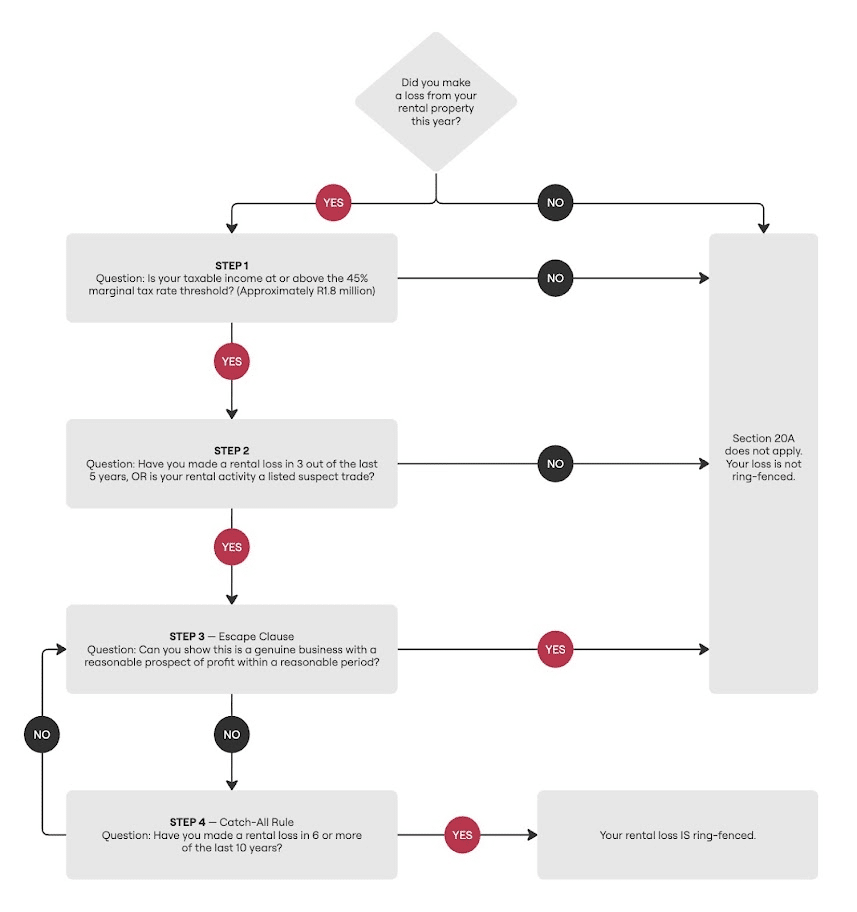
Ring-fencing is not an automatic route to be taken. SARS follows a four-step process to decide whether to ring-fence your rental losses or not:
Step 1: Are You a High-Income Earner?
Your taxable income (before taking the rental loss into account) must be high enough to reach the maximum marginal tax rate of 45%. For recent tax years, this threshold has been around R1.8 million.
If your income is below this level, you’re unlikely to face ring-fencing by SARS.
Step 2: Do You Encounter Recurring Losses or Have a “Suspect Trade”?
SARS will consider ring-fencing if either:
- You’ve made a loss from your rental activity in at least three out of the last five years, or
- Your rental activity is classified as a “suspect trade”. This includes residential rental accommodation unless at least 80% of your rented accommodation is leased to unrelated persons. This is for at least half the year.
Step 3: Can You Escape Rental Loss Ring-Fencing in South Africa?
Even if you fit the criteria in Steps 1 and 2, you can escape ring-fencing if you can demonstrate that your rental activity:
- Operates as a genuine business, and
- Shows a reasonable prospect of making taxable income within a reasonable foreseeable timeframe.
This is known as the “facts and circumstances” test. It gives you an escape route if you can prove you’re running a serious, profit-oriented rental business.
Step 4: The Six-Out-of-Ten-Years Rule
Please note: There’s a catch: if you’ve made losses in six or more of the last ten years (including the current year), you can’t use the escape clause laid out in Step 3. At that point, SARS will ring-fence your rental losses regardless.
What Should You Do When You File Your Tax Return?
If you’re a property investor in the beginning leg of building your portfolio, and you don’t meet the conditions for ring-fencing (particularly if your income is below the R1.8 million threshold), and you only have one property held in your own name (not in a company and trust structure) do not select to ring-fence your rental losses unless SARS specifically requires it.
– Tamzin MacDonald, Financial Manager, IGrow Accounting and Tax Advisory
“Allowing SARS to ring-fence losses when it’s not required means you are voluntarily giving up tax relief you’re entitled to at the moment.”
Just be aware that, because SARS monitors rental income closely, you may need to provide proof of a genuine loss, including lease agreements, levies and rates invoices, and bank statements showing bond interest payments. This is easy to upload when e-filing, and you should keep these on file, ready for tax season in any case. We strongly recommend speaking to a tax accountant with property experience to help you when filing your returns.
We’ve created this handy decision tree to help you with your filing. Please remember this does not replace professional advice from a qualified tax practitioner.
Final Thoughts
For South African property investors in the early days of building a property portfolio, understanding how SARS works is important. It is particularly important when it comes to deciphering rental losses. This allows you to plan with clarity rather than frustration.
Because the Section 20A Income Tax Act is complicated and highly fact-specific, we strongly recommend seeking professional tax advice. This will ensure compliance and optimise your long-term tax position.
Contact IGrow Accounting and Tax Advisory to book a free, no-obligation consultation. So, we can discuss your ring-fencing options and whether or not they suit your unique property investment set-up.
You can also call directly on (021) 979 2501, or email info@igrow.co.za to make an appointment.