A large number of South Africa’s well-paid professionals share something in common. Regardless of whether you’re a doctor, dentist, lawyer, engineer, architect or specialist consultant, your income is tied to how many hours you work. If you are being paid for your time, your earning potential has a limit.
In a day, you can only attend to a set number of patients, meet a certain number of clients or finish as many projects as possible. If you take on too much, you risk burnout or a genuine drop in the quality of care for your clients or patients. The rise in inflation and higher living costs means many paid professionals have difficulty building lasting wealth from their earnings.
The question is: if you can’t find more hours in a day, how can you grow your income without scaling back on your quality of life?
The answer potentially lies in passive property investment.
Why working harder isn’t always the solution
Many working professionals spend years getting expensive qualifications and nurturing successful careers. While this can lead to a stable, strong income, it doesn’t easily allow for building real financial freedom.
When you are paid for your time, an increase in your income requires your extra effort. It is evident that tackling more work simply is not sustainable. Rather than depending only on active income, many successful investors concentrate on building assets that create income independently. This means your capital begins working for you while you focus on your profession.
Put your income to work
A key perk of passive property investment is leverage. Instead of relying only on your work income, you can utilise it to purchase income-generating assets. Buy-to-let property generates passive monthly rental income and benefits from long-term capital growth.
With time, rental rate escalations, rental income and property appreciation can work for you and increase your net worth. You won’t have to put in extra working hours. This is ideal for high-income earners, whose incomes provide the financial foundation for property investment.
Rather than earning only once for every hour you’ve worked, you create multiple streams of passive rental income for years to come.
How inflation affects matters
South Africans continue to feel the impact of rising living costs and inflation affecting everything from their groceries to their municipal services and insurance premiums. Even professionals with high monthly incomes find that lifestyle costs are increasing with time.
“The cost of living rose by 3,1% in the 12 months to March [2026], according to the latest consumer price index (CPI). This is slightly up from 3,0% recorded in February.” (Source)
If you are paid for your time, your income increases may not keep up with inflation unless you work more hours or charge increased fees. For professionals like doctors and dentists, whose fees are regulated and also capped by what Medical Aids will pay out, keeping up with inflation on both work expenses and lifestyle costs can be a genuine concern.
Being an owner of investment property provides a buffer against inflation as rental income and property values both increase over the long term, and your earnings from them are not linked to your personal work hours.
Reducing your tax burden while building wealth
Optimising your tax efficiency plays an important role in a long-term wealth strategy. One of the lesser-known opportunities available to qualifying investors is the Section 13 Sex Tax Act incentive.
Qualifying IGrow investors who own at least five new residential rental units can claim valuable annual deductions in taxable income for 20 years. This makes property investment even more lucrative. The allowance aims to encourage investment in new residential rental housing and is an important tax incentive for qualifying investors. (Source)
View our handy blog post that goes into the finer details of the Section 13 Sex Tax Act.
Understanding the Section 13 Sex Tax Act and how it applies to you could form part of a broader financial and tax planning strategy for qualified professionals.
Another important factor is structuring property investment correctly. When you earn in a higher tax bracket, you don’t want to risk losing additional income to taxes. IGrow recommends structuring a property portfolio so that you are a director of a property company that owns the properties (companies pay much lower tax than individuals) and then have a trust that owns shares in that company.
You can pay yourself and dependent family members through the trust to cover living expenses, and spread your tax burden out among lower-earning family members, from spouses to children or elderly parents. This way you can cover, for example, an ageing parent’s old age home fees or medical care via the trust, and that income from your properties is only taxed at your retired parent’s marginal rate, not your higher rate as a professional.
Important to note: IGrow offers
You can learn more about this structure from the Head of IGrow Trusts in this video:
A smart way to build a portfolio
A lot of professionals presume buying five investment properties is not realistic. Yet, having a structured investment strategy can make property portfolio expansion more actionable than you thought possible.
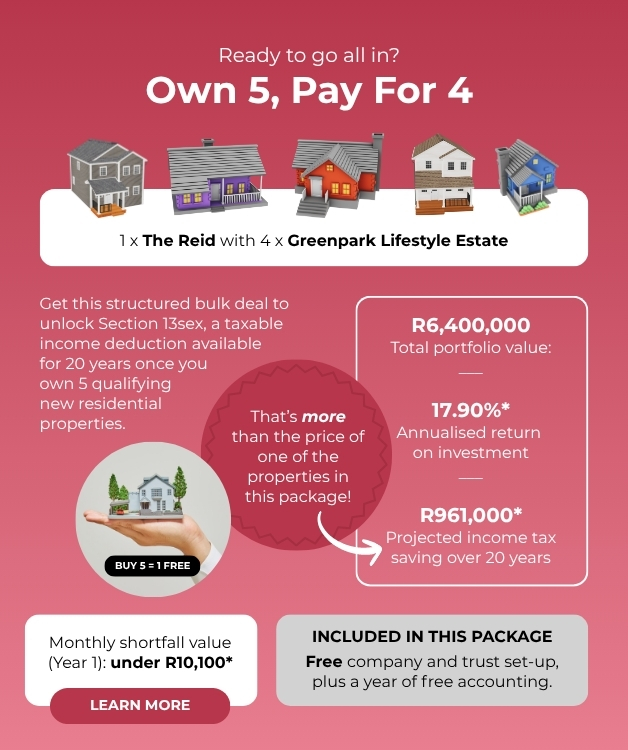
IGrow has developed a Limited Bulk Deal that allows qualifying investors to acquire 5 investment properties in one transaction. This springboards portfolio growth while positioning investors to qualify for valuable tax incentives like the Section 13 Sex Tax Act.
The bulk deal offers exclusive and significant discounts on fees and property management fees, as well as free company and trust set-up and free accounting fees for one year. For as little as R10,080 per month for the first five years, you own five properties that will give you significant income and equity to leverage further down the line.
This approach means high-income earners can use their strong earning capacity to purchase long-term wealth-producing assets. They won’t have to rely on future salary increases.
Conclusion
Being paid for your time doesn’t automatically mean your income is capped. If you combine passive property investment with strategic financing and tax planning, professionals can create wealth that reaches further than the hours open to you in each day.
Your goal may be earlier financial independence, extra retirement income or leaving a legacy for your family. With passive property investment, your money works for you while you sleep. It accumulates through passive rental income after you’ve seen your clients of left the office.
If your skills have built your income, maybe it’s time to let your investment property help build your wealth.
Contact an IGrow Property Investment Strategist today and let’s start your path to a passive income stream.
FREQUENTLY ASKED QUESTIONS
Passive property investment is a strategy where your investment property generates income and has the potential to grow in value over time without requiring your daily involvement. With professional property management, investors can earn rental income while focusing on their careers.
Professionals such as doctors, lawyers, dentists and engineers often have limited earning capacity because their income is linked to the hours they work. Investment property can generate passive rental income and long-term capital growth, allowing them to build wealth without taking on more clients or extending their working hours.
The Section 13 Sex Tax Act is a South African tax incentive aimed at encouraging investment in new residential rental properties. Qualifying investors who own at least five eligible residential rental units may be able to claim building allowances that reduce their taxable income. Always consult a qualified tax practitioner to determine whether you qualify.
Yes. Many investors use professional property investment companies and rental management services to help source, finance and manage their properties. IGrow Rentals offers discounted rates to our investors for full-service property and tenant management. This allows busy professionals to build a property portfolio while spending minimal time on day-to-day management.